
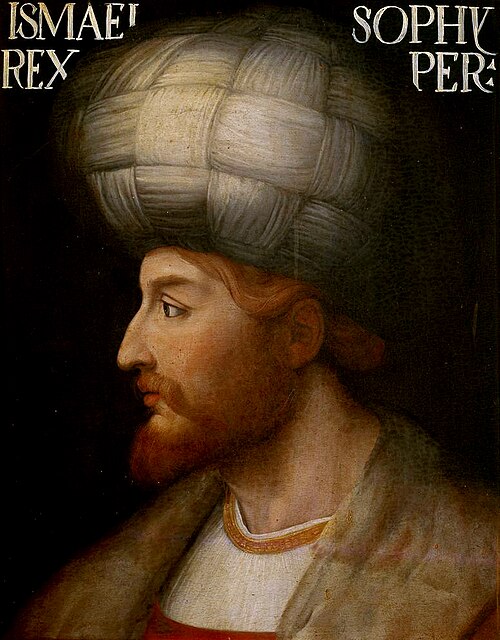
Файл:Portrait of Shah Ismail I. Inscribed "Ismael Sophy Rex Pers". Painted by Cristofano dell'Altissimo, dated 1552-1568.jpg

Краткое описание
| Описание |
العربية: لوحة لإسماعيل الصفوي رسمها الرسام الإيطالي كريستوفانو ديل ألتيسيمو بين عامي 1552 و1568. محفوظة في معرض أوفيزي، فلورنسا.
English: Portrait of Shah Ismail I, painted by Cristofano Dell'Altissimo between 1552 and 1568.
Panel/oil painting. Inscribed "Ismael Sophy Rex Pers". (Casale, Sinem Arcak (2023). Gifts in the Age of Empire: Ottoman-Safavid Cultural Exchange, 1500–1639. University of Chicago Press. p. 34. ISBN 978-0226820422.) Housed at the Galleria degli Uffizi, Florence. The idea of a universal gallery made up of portraits of illustrious men was thanks to Cosimo I de' Medici. In 1552, the duke of Tuscany sent the painter Cristofano dell'Altissimo to Como to copy the collection of portraits of illustrious men that the learned bishop Paolo Giovio, who had recently died in Florence, had collected in his villa on the lake from 1521. It was a very rare collection, the most important of its kind, both for the presence of numerous splendid originals and for the large number of subjects. Copies were sent from Como in groups from 1552 to 1587/89, so much so that Vasari, in the second edition of the "Lives" (1568), lists 280 portraits already present in Florence. In the meantime, Vasari himself had set up for Cosimo, in Palazzo Vecchio, a room annexed to the rooms of the Guardaroba, the so-called room of the Globe or of the geographical maps, destined to welcome in a particularly worthy setting also the collection of portraits of illustrious men who hand was forming. The program so loved by Cosimo I did not bear fruit with the new Grand Duke Francesco, while it resumed immediately and in full with the accession to the throne of Ferdinand I. Between 1587, the initial year of his government, and 1591 he arranged for the transfer collection of portraits in the corridor of the Uffizi; in 1597 the diplomatic traveler and writer from Vicenza Filippo Pigafetta rearranged the collection according to the "dignities and professions" and highlighted the most serious gaps in order to then complete and update the whole series. The Giovian collection was continued until 1840, today it has 492 pieces and is extraordinarily important from a historical-iconographic, if not stylistic, point of view. The portrait in question, mentioned in Vasari's list of 1568, depicts Ismail I Sophy (1487/1524). King of Persia, founder of the Safawid dynasty, who fought against the Turks. Cristofano produced the portrait (c. 1552–68), long after Ismail’s death, by copying from Paolo Giovio’s “Giovio series” — which gathered images sourced from travelers and diplomats rather than from a live sitting. As a result, it's believed the painter may have idealized Ismail’s features, adapting them to the aesthetics of the Florentine school. Research highlights that while copying Giovio’s originals, Cristofano “made some changes in the solution of portrait composition … painted it in his own way”. That suggests stylistic reimagining rather than strict fidelity. He may have enhanced spiritual attributes, aligning the image with European expectations of a “Sufi‑saint‑king,” as Giovio’s writings depicted him. (1 January 2020). "Identification of portrait featuresof Shah Ismail I according to the 16th century european sources". Problems of Arts and Culture. International scientific journal.
Русский: Исмаил 1й 1487-1524 English: Portrait of Shah Ismail I of iran (1487-1524) Deutsch: Schah Ismail I. (1501–1524), Porträt aus dem 17. Jahrhundert Azərbaycanca: Şah İsmayılın XVI əsrdə florensiyalı rəssam Kristofano Dell’Altissimo tərəfindən çəkilmiş portreti (Uffitsi muzeyi, Florensiya, İtaliya). Bahasa Melayu: Lukisan Ismail I dari Parsi (1487-1524)
Italiano: Serie Gioviana. Cristofano dell'Altissimo, Ritratto di Ismail I Sophi, 1552-68 circa. Re di Persia, 1487-1524, fondatore della dinastia dei Safawidi. |
|||||||||||||||||||||||
| Дата | между 1552 и 1568 | |||||||||||||||||||||||
| Источник | https://catalogo.uffizi.it/it/29/ricerca/detailiccd/1187797/ | |||||||||||||||||||||||
| Автор |
|
|||||||||||||||||||||||
| Права (Повторное использование этого файла) |
PD because of age | |||||||||||||||||||||||
| Другие версии |
 _by_Giovio,_Paolo,_1483-1552.jpg) |
|||||||||||||||||||||||


Лицензирование
|
Это изображение является точной фотографической репродукцией оригинального двумерного произведения изобразительного искусства. Данное произведение изобразительного искусства само по себе находится в общественном достоянии по следующей причине:
Официальная позиция, занятая «Фондом Викимедиа», заключается в том, что «точные репродукции двумерных произведений изобразительного искусства, находящихся в общественном достоянии, также находятся в общественном достоянии, и заявления об обратном представляют собой нападки на саму концепцию общественного достояния». Для получения подробной информации см. Commons:Когда использовать тег PD-Art.
Эта фотографическая репродукция, следовательно, также считается находящейся в общественном достоянии. Просим учитывать, что в зависимости от местного законодательства повторное использование этого контента может быть запрещено или ограничено в вашей юрисдикции. См. Commons:Когда использовать тег PD-Art. | ||||


История файла
Нажмите на дату/время, чтобы увидеть версию файла от того времени.
| Дата/время | Миниатюра | Размеры | Участник | Примечание | |
|---|---|---|---|---|---|
| текущий | 12:31, 16 октября 2014 | | 776 × 993 (438 КБ) | wikimediacommons>مانفی | quality |
Использование файла
Следующая страница использует этот файл:
